Türkçe
Basilica Cistern travel guide • Things to do in Istanbul • Historic Peninsula hidden gems
Introduction
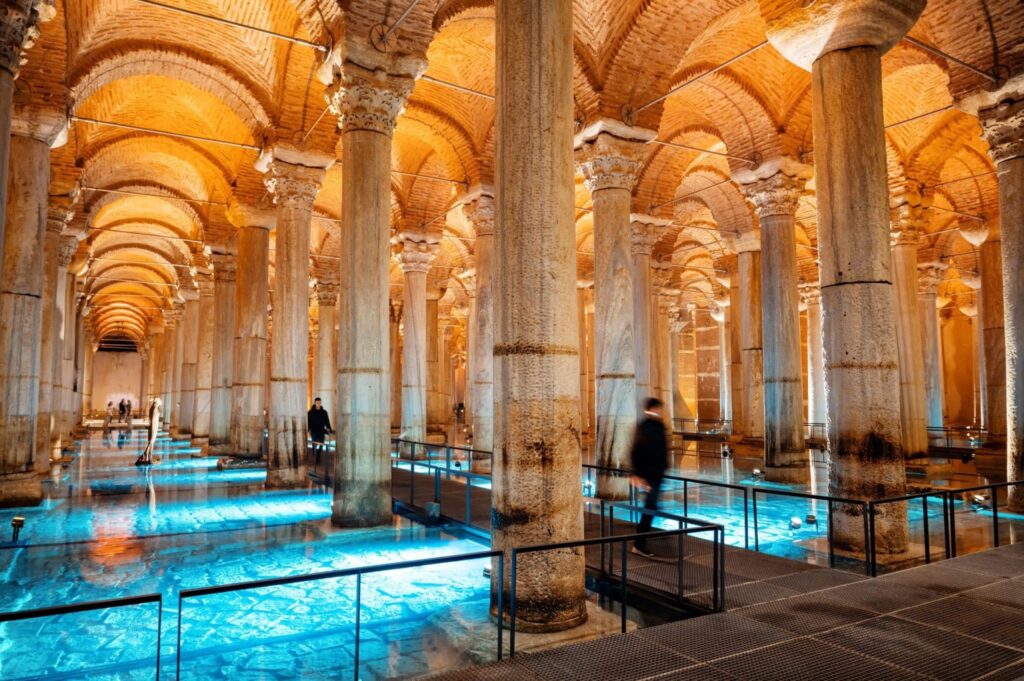
If you’re looking for something truly atmospheric and unlike anything else in Istanbul, the Basilica Cistern (Yerebatan Sarnıcı) is it. Descend into its cool, dimly lit interior, and you’ll find yourself in a forest of ancient columns reflected in still, dark waters—a place that feels more like a setting for legends and ghost stories than a functional piece of ancient engineering.
It’s one of the most evocative places in the city. Let’s take a deep dive (pun intended!) into its history, architecture, highlights, and practical tips for visiting.
🌟 A 6th-Century Wonder
Built during the reign of Emperor Justinian I in the 6th century, the Basilica Cistern was designed to supply water to the Great Palace of Constantinople and surrounding buildings. The name “Basilica” comes from the fact it was built beneath a large basilica that once stood here.
What’s truly remarkable is the scale and ambition: a vast underground reservoir capable of holding around 80,000 cubic meters of water. It was fed by aqueducts from the Belgrade Forest, 19 kilometers away—a marvel of ancient engineering.
When you visit today, you’re walking through history that kept a city alive through sieges and droughts. The Ottomans also used it for centuries but eventually let it fall into obscurity, only to be rediscovered by Western travelers in the 16th century.
🏛️ Architectural Features: A Forest of Columns
Stepping inside feels like entering another world. The cistern measures 140 meters by 70 meters and is supported by 336 marble columns, each about 9 meters tall. Many of these columns were repurposed from older Roman and Greek structures, giving the space an eclectic, patchwork feel.
Highlights include:
-
Medusa Heads: Two columns in the northwest corner sit on massive carved Medusa heads, one sideways, the other upside-down. Their origin is mysterious—likely re-used Roman art—and they add an eerie beauty.
-
Column of Tears: This column is carved with peacock-eye patterns and perpetually damp, thought to commemorate the hundreds of slaves who built the cistern.
-
Vaulted Brick Ceiling: The beautiful arches overhead distribute weight while creating a mesmerizing rhythm of light and shadow.
Soft lighting and the gentle echo of dripping water create a hushed, almost sacred atmosphere. It’s easy to see why filmmakers chose it as a location for movies like From Russia with Love and Inferno.
🌊 From Vital Infrastructure to Tourist Gem
For centuries, the Basilica Cistern was essential for Constantinople’s survival. Even during sieges, it ensured the city never ran dry. But after the Ottoman conquest, its use declined as the Topkapı Palace built its own water supply systems.
By the 19th century, it was semi-forgotten—local people would lower buckets through holes in the floor of their houses to fetch water (and sometimes fish!). It was only in the 20th century that restoration turned it into the atmospheric tourist site you see today.
📸 Insider Travel Tips
✔️ Best time to visit: Early morning to avoid long lines.
✔️ Tickets: Usually a modest fee; buy online or on-site.
✔️ Accessibility: Walkways are well-maintained but can be slippery—wear good shoes.
✔️ Photography: Absolutely allowed—and encouraged! Tripods usually aren’t.
✔️ Season: A perfect place to cool off in summer heat.
❤️ Why You’ll Love It
The Basilica Cistern is pure magic. It’s not just another monument but an experience—a cool, shadowy, almost mystical space beneath one of the world’s busiest cities.
Whether you’re a history buff imagining Byzantine engineers planning aqueducts, a photographer chasing reflections and shadows, or just a traveler seeking something truly different, you’ll walk away amazed.