
 Türkçe
Hippodrome Istanbul travel guide • Sultanahmet Square attractions • Things to do in Istanbul Historic Peninsula
Introduction
Imagine a roaring crowd of 100,000 people, cheering on thundering chariot races, chanting for their favorite teams, or even rioting against the emperor himself. Welcome to the Hippodrome of Constantinople—today known as Sultanahmet Square.
What seems like a calm, open plaza today was once the beating heart of Byzantine public life. It’s one of Istanbul’s most fascinating historical spaces, layered with monuments that tell stories of ancient empires, brutal rebellions, and cultural exchange. Let’s explore it together.
🌟 A History of Spectacle and Power
The Hippodrome was originally begun in the 3rd century CE under Emperor Septimius Severus but was dramatically expanded by Emperor Constantine the Great when he made Constantinople his new imperial capital in the 4th century.
It was more than just an arena. Think of it as the social media of its day—a place where politics, sport, religion, and popular culture all collided.
Chariot racing was the superstar entertainment of the time. Fans were fiercely loyal to their factions—the Blues and the Greens—and their rivalry wasn’t always friendly. The most notorious moment was the Nika Revolt of 532, when racing crowds turned into a rebellious mob that nearly overthrew Emperor Justinian.
Over the centuries, the Hippodrome witnessed triumphal parades, coronations, and diplomatic ceremonies. Even after the Ottoman conquest in 1453, the space remained important—though the races ended, the Ottomans used the square for festivals and gatherings.
🏛️ Surviving Monuments: Ancient Art in the Open Air
While the grand stands and imperial box (Kathisma) are long gone, the Hippodrome retains several spectacular monuments in situ. Walking through the square today is like visiting an open-air museum:
-
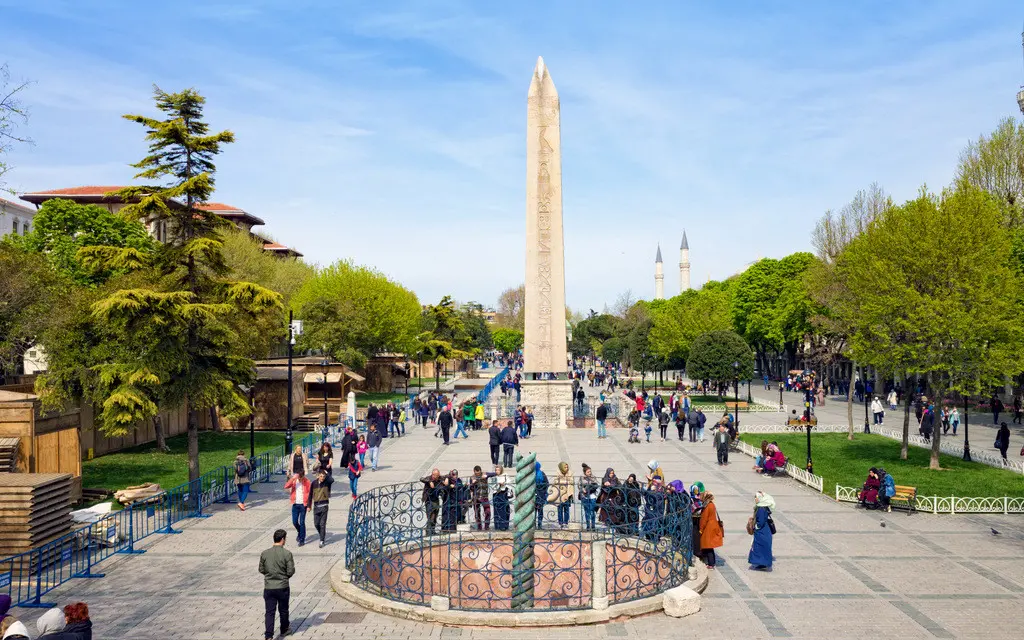
Egyptian Obelisk: Originally erected in Luxor by Pharaoh Thutmose III (~1500 BCE), this pink granite monument was brought to Constantinople in the 4th century. The Romans cut it into pieces for transport and reassembled it here. Look for the intricate reliefs on its marble base showing Emperor Theodosius watching chariot races.
-
Serpent Column: Even older, this twisted bronze column came from Delphi, Greece. Originally part of a giant sacrificial tripod dedicated to Apollo after the Greek victory over the Persians in 479 BCE. Its serpent heads were lost over time (one is in the Istanbul Archaeology Museum).
-
Walled Obelisk: Built of rough masonry in the 10th century under Emperor Constantine VII. Though less flashy, it’s impressive for its size and historic role as the central spine of the racing track.
-
German Fountain: A later addition from 1900, gifted by Kaiser Wilhelm II. Its green dome and neo-Byzantine style are beautiful, and it symbolizes the late Ottoman-German friendship.
🧭 Walking Through History
Today’s Sultanahmet Square is a peaceful, pedestrian-friendly plaza where you can literally walk the old Hippodrome track. It’s surreal to think you’re standing where emperors, gladiators, and racers once performed for the roaring masses.
Stroll slowly and read the plaques, or just sit on a bench watching Istanbul life go by, from street vendors selling roasted chestnuts to kids chasing pigeons. The vibe is friendly, relaxed, and perfect for people-watching.
📸 Insider Travel Tips
✔️ Best time to visit: Early morning for photos without crowds, or evening for cooler weather and street life.
✔️ Cost: Free! It’s an open public space.
✔️ Accessibility: Fully walkable and accessible, though cobblestones can be uneven.
✔️ Nearby sights: Ayasofya, Blue Mosque, Basilica Cistern—all literally steps away.
✔️ Photography: The monuments look beautiful at dawn and dusk. Don’t miss detailed shots of the Obelisk reliefs.
❤️ Why You’ll Love It
The Hippodrome isn’t a building you can enter—it’s a space you feel. It’s one of those places where Istanbul’s layers really hit you: an ancient Roman stadium that became a Byzantine showpiece, then an Ottoman ceremonial square, and now a public park shared by tourists and locals alike.
If you want to stand somewhere and just feel history swirling around you, this is it.